These rules will not make you rich overnight. But breaking them consistently will make you poor. Study them, apply them, and revisit them every time a trade goes wrong.
Rule 1: Most Stocks Don't Run Forever — Book at 40–50%
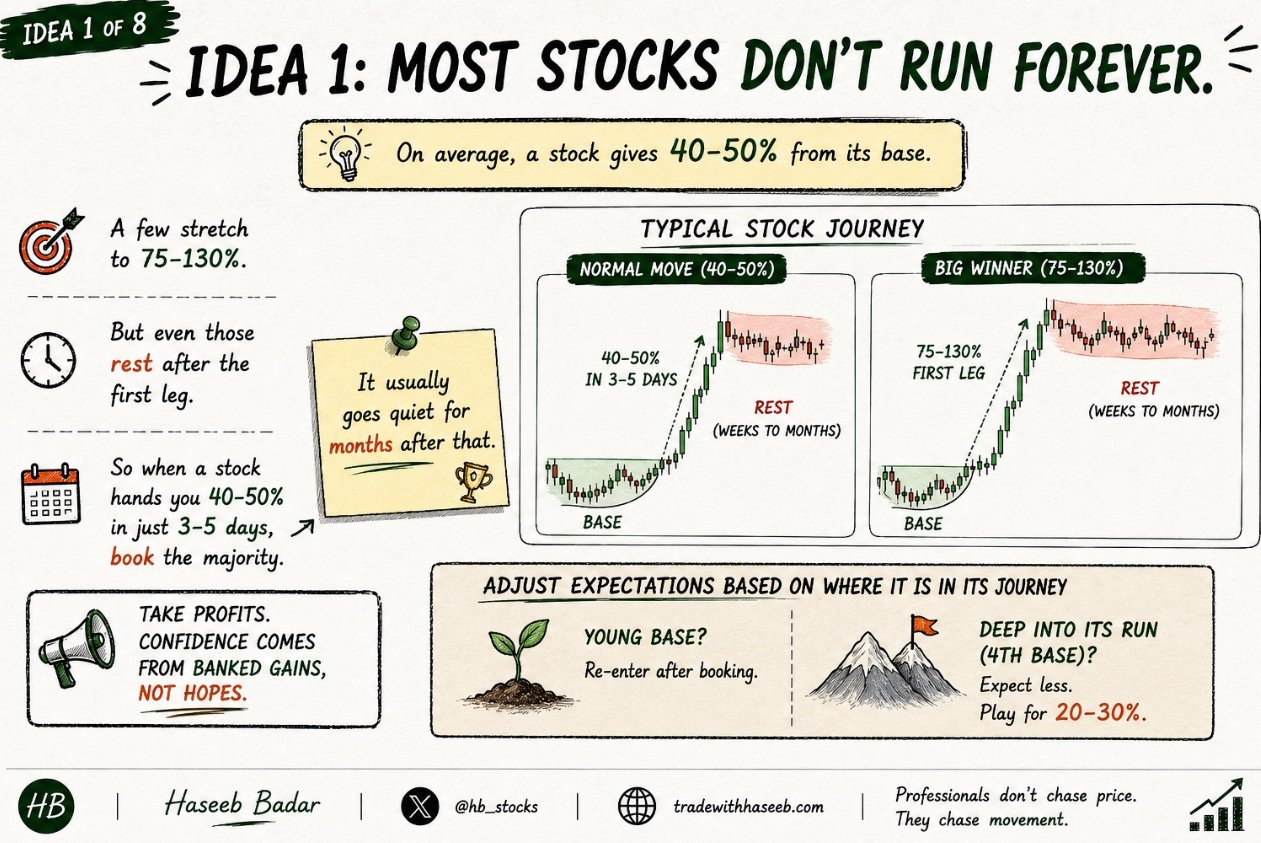
The market is generous in short bursts and brutal to those who overstay their welcome. On average, a stock delivers 40–50% from its base before it needs to rest — and that rest can last weeks or months. When a stock hands you that gain in just 3–5 days, it is not being kind. It is paying you early. Book the majority of your position, protect the profit, and let the small remainder ride. Confidence in trading comes from banked gains, not from hopes that never materialise.
Rule 2: Volume Is the Truth Serum — It Confirms Real Moves
Price tells you what a stock did. Volume tells you who did it and whether it matters. A breakout on thin, below-average volume is a rumour — retail noise with no institutional conviction behind it. But when a stock clears resistance on volume that is 50% or more above its 50-day average, that is institutions quietly loading up. Watch for volume to dry up completely during the rest phase too — that silence means sellers have left the building and the next move could be explosive.
Rule 3: The Base Is Where Fortunes Begin — Quality Matters
Nobody gets rich buying a stock already mid-run. The real money is made by those patient enough to identify a proper base and wait for the breakout. A good base is at least 6–8 weeks of tight, controlled price action with declining volume — institutions are accumulating shares without tipping their hand. The shallower and tighter the base, the more powerful the breakout tends to be. A loose, erratic base with wide price swings is a warning, not an invitation — skip it and wait for a cleaner setup.
Rule 4: Cut Losses — Protect Capital Before Chasing Profit
The mathematics of loss is brutal and non-negotiable. A stock that falls 50% needs to rise 100% just to get you back to even — and that can take years. The professional move is to sell any position that falls 7–8% below your entry, without debate, without waiting for one more day. Your stop loss is not an admission of failure. It is the single most important tool in your arsenal because it guarantees that no single bad trade can destroy your account. The first loss is always the smallest loss.
Rule 5: Never Average Down — Pyramid Up on Winners
Averaging down feels logical — you are buying more of something you already liked at a cheaper price. But the market does not care what you paid. When a stock falls after your entry, it is the market telling you that you were wrong, at least for now. Adding to a losing position is your ego fighting the tape, and the tape always wins. Instead, add to positions that are already working — buy a smaller second tranche after the stock breaks out further and holds. Pyramid up on strength, never down on hope.
Rule 6: Market Context Rules Everything — Read the Tide
Even the best stock in the world struggles when the broader market is in a downtrend. Studies show that in a strong bull market, three out of four stocks rise regardless of their individual fundamentals — the tide lifts everything. In a bear market, that same relationship works in reverse and drags even strong stocks down with it. Before you enter any trade, ask yourself where the index is trending, whether new highs are expanding or contracting, and whether breakouts across the market are holding or failing. Your individual trade does not exist in isolation — it lives or dies with the broader environment.
Rule 7: Patience Is a Position — Wait for the Fat Pitch
The biggest misconception in trading is that activity equals progress. The best traders in the world are inactive most of the time — they are watching, waiting, and preparing rather than buying and selling. Cash is not dead money sitting on the sidelines. It is loaded capital waiting for the right pitch, and holding it during a choppy or declining market is itself a form of outperformance because your principal stays intact. You do not need to trade every day or every week. You need to trade correctly a handful of times a year, and the discipline to wait for those moments separates professionals from gamblers.
Rule 8: Your Journal Is Your Edge — Log Everything
Every professional trader keeps a journal, and it is not because they enjoy admin work. It is because patterns in your own behaviour — your entries, your exits, your emotional state, your reasoning — are the most valuable data set you will ever have access to. After every single trade, write down why you entered, what you expected, what actually happened, and how you felt at each stage. Review your losing trades first and look for the recurring mistakes. In six months, the patterns in your journal will tell you more about how to improve than any book, course, or guru ever could.